KernelSU Next + SusFS is the Ultimate Weapon.
"There is a moment when you realize your phone has always been more than what the manufacturer intended it to be."

Most people use their Android phones the way a factory intended. Within the lines, inside the sandbox, never questioning what lies beneath the surface. And for years, that was fine. The software did what it needed to do. The hardware ran what it was told to run.
But somewhere along the way, a quiet revolution began. Not in boardrooms or product keynotes, but in kernel source trees, GitHub repositories, and late-night Telegram groups. A revolution that turned the humble Android device into something far more powerful than any manufacturer ever designed it to be.
That revolution has a name: KernelSU Next + SusFS.
The Problem with the Old Guard
For the better part of a decade, Magisk was the gold standard of Android rooting. It was elegant, it was effective, and it worked. You installed it, you got root, you hid it from apps that did not want to see it. Simple.
But the world moved on. Google tightened its grip with the Play Integrity API. Banking applications began deploying aggressive root detection. Game developers embedded anti-cheat systems that specifically targeted Zygisk, the very mechanism Magisk relied on to inject itself into running processes.
Magisk became a target. Not because it was bad, but because it was too well-known. Its patterns were documented. Its hooks were predictable. And in the arms race between root solutions and detection systems, predictability is a death sentence.
Enter KernelSU Next
KernelSU, originally created by tiann, introduced a fundamentally different approach to rooting. Instead of injecting itself after the system had already booted, the way Magisk does, it embedded root access directly into the Linux kernel itself.
Think about the difference for a moment. Magisk is like someone who picks the lock on the front door and sneaks in after everyone is already home. KernelSU is like being built into the foundation of the house. You are not a guest. You are part of the structure. The house does not know you are there because, as far as it is concerned, you have always been there.
KernelSU Next takes this concept further. As a refined fork of the original project, it brings a set of capabilities that make it significantly more versatile.
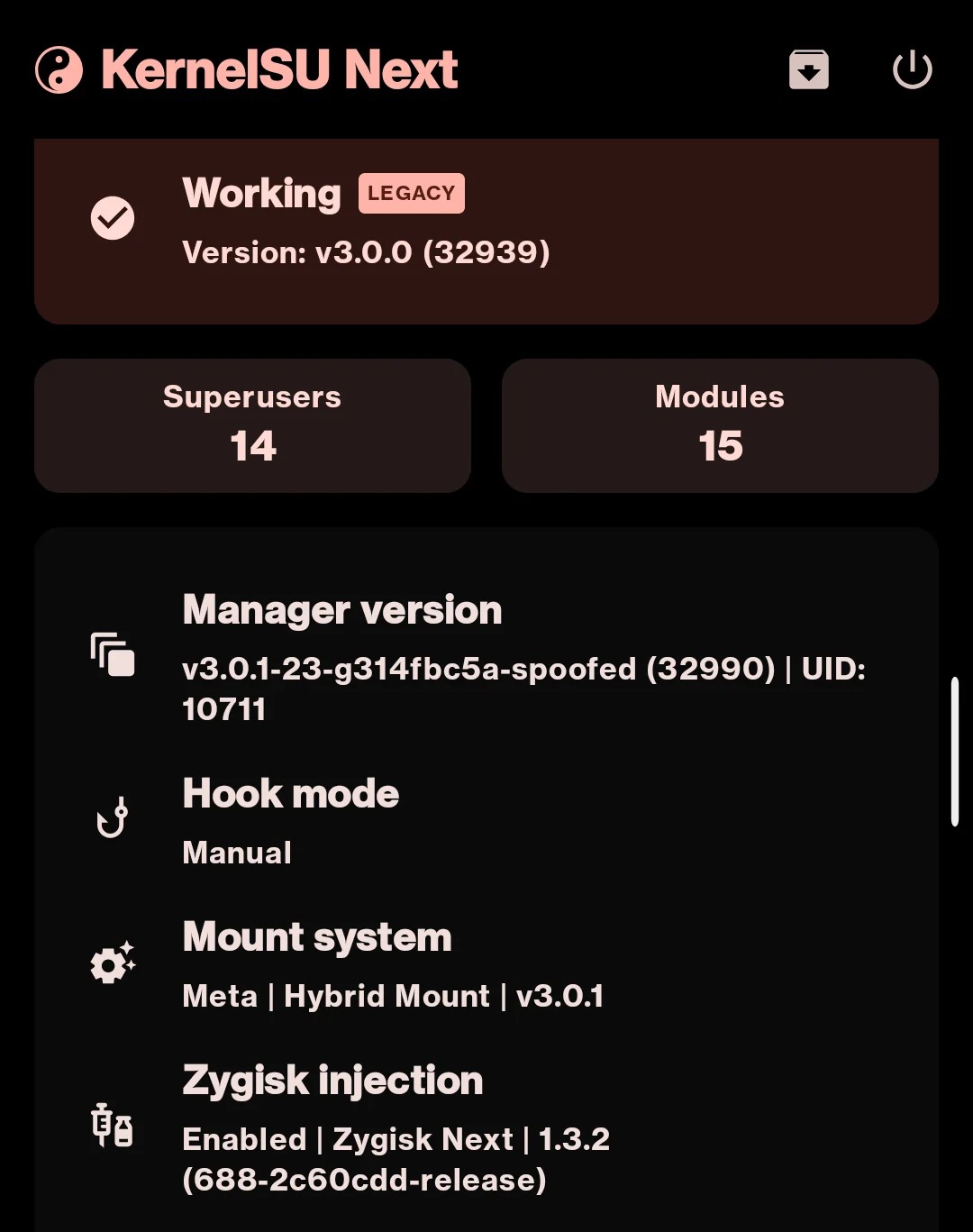
It covers a vast range of devices, supporting both Non-GKI kernels (4.x through 5.4 LTS) and GKI kernels (5.10 through 6.6). It introduces Dynamic Magic Mount and OverlayFS, allowing you to modify the system without ever touching the actual system partition. Your module configurations and SU allowlists can be backed up and restored across entirely different devices. The Hybrid Mount system (Meta | Hybrid Mount) gives you the flexibility to choose exactly how modules interact with the filesystem. On top of all that, the manager interface has been completely redesigned to be clean, modern, and built for clarity, and it keeps itself current through automatic updates.
But KernelSU Next, powerful as it is, is only half of the equation.
SusFS: The Art of Being Invisible
If KernelSU Next gives you root, SusFS makes sure nobody ever finds out.
SusFS, or Systemless Userspace File System, is a kernel-level root hiding framework. That distinction matters. Every major root detection tool in existence today (Play Integrity, SafetyNet, proprietary banking checks) operates above the kernel. They scan the Android framework. They inspect running processes. They check mount points and file paths.
None of them look inside the kernel itself.
This is what makes SusFS different from everything that came before it. MagiskHide worked at the userspace level. Zygisk hooks were detectable because they modified process behavior in ways that left traces. SusFS operates beneath all of that, at the very layer where the operating system begins.
Its core capabilities are straightforward, but devastating in their effectiveness. Root hiding happens at the kernel level, making it invisible to any scan operating above it. The architecture is entirely systemless, leaving no modifications to the system partition and no forensic traces behind. Kernel strings like uname -r and uname -v can be spoofed to return whatever values you configure. Verified Boot Hash injection ensures the bootloader sees a clean, unmodified partition. And all of this runs with minimal performance overhead, lighter than any Zygisk-based solution.
"Magisk can hide root. SusFS makes it as though root was never there."
Three Layers Deep
SusFS does not rely on a single trick. It operates across three distinct hiding mechanisms, each targeting a different attack surface:
sus_umount is the first line. Once a module has done its job, the mount is cleanly removed. To any process that checks afterward, there is no record of the modification ever existing. It is the equivalent of cleaning up after yourself so thoroughly that no forensic team could find a fingerprint.
sus_mount goes deeper. It hides active mounts from /proc/pid/mount and mountinfo, the two places where any competent detection system would look for evidence of overlay modifications. Modules remain functional, but their presence is erased from the system's own accounting.
sus_path is the most aggressive layer. It intercepts and suppresses propagation across multiple syscalls, making it possible to hide system-level files like recovery scripts, addon configurations, anything that might betray the fact that this device has been modified. This is not a feature to use casually. It is a scalpel, not a sledgehammer.
Together, these three layers create a defense in depth that no current detection framework can penetrate.
What This Means in Practice
The implications are significant. With KernelSU Next and SusFS working together, a device can pass Strong Integrity verification, the highest tier of Google's Play Integrity API, something Magisk-based setups can no longer reliably achieve. Banking and financial applications run without triggering a single root detection flag. Games with aggressive anti-cheat systems operate normally while full module functionality is maintained underneath. System-wide modifications like ad blocking, DNS customization, and debloating remain completely invisible to inspection.
The device presents itself as stock. Untouched. Factory-fresh. Meanwhile, beneath the surface, it is running a fully customized environment with root access, active modules, and complete user control.
This is what it means to have a device without limits. Not because you have broken something, but because you have unlocked everything. Quietly, cleanly, and without compromise.
The Stack That Makes It Work
For those interested in the practical implementation, this is the configuration that has become standard across the community.
It starts with KernelSU Next as the root manager, operating in Magic Mount mode. The SusFS module sits on top, handling all root hiding at the kernel level. Zygisk Next provides compatibility for modules that still depend on Zygisk. LSPosed, specifically the JingMatrix fork, opens the door to the entire Xposed module ecosystem. PlayIntegrityFix ensures that integrity attestation passes cleanly. TrickyStore manages keybox attestation. And HideMyApplist prevents detection through installed application enumeration.
Each component serves a specific purpose. There is no redundancy. The result is a device that passes Native Detector, Holmes, and every other publicly available root detection tool. Completely clean, every time.
Looking Forward
The history of Android rooting is a history of escalation. Every time Google raises the wall, the community finds a way over it. Or, more accurately, a way through it that Google cannot see.
KernelSU Next + SusFS represents the current peak of that effort. It is not a hack. It is not a workaround. It is a fundamental rethinking of where root access should live and how it should behave, moving it from the visible application layer down into the invisible kernel layer, where detection becomes not just difficult but architecturally impossible.
Whether this equilibrium holds is another question. Google will adapt. Detection methods will evolve. The next chapter of this arms race has not been written yet.
But for now, this much is clear:
Your phone was always capable of more than you were told. KernelSU Next + SusFS simply proves it.